

But With Whom, Exactly, Are We Supposed to be Communing?
A reflection on our modern evangelical practice of communion.

For those of us in Protestant, Evangelical, or Pentecostal circles, has anyone else grown up wondering about these verses when taking communion?
1 Corinthians 11:27-29 (KJV)
27 Wherefore whosoever shall eat this bread, and drink this cup of the Lord, unworthily, shall be guilty of the body and blood of the Lord. 28 But let a man examine himself, and so let him eat of that bread, and drink of that cup. 29 For he that eateth and drinketh unworthily, eateth and drinketh damnation to himself, not discerning the Lord’s body.
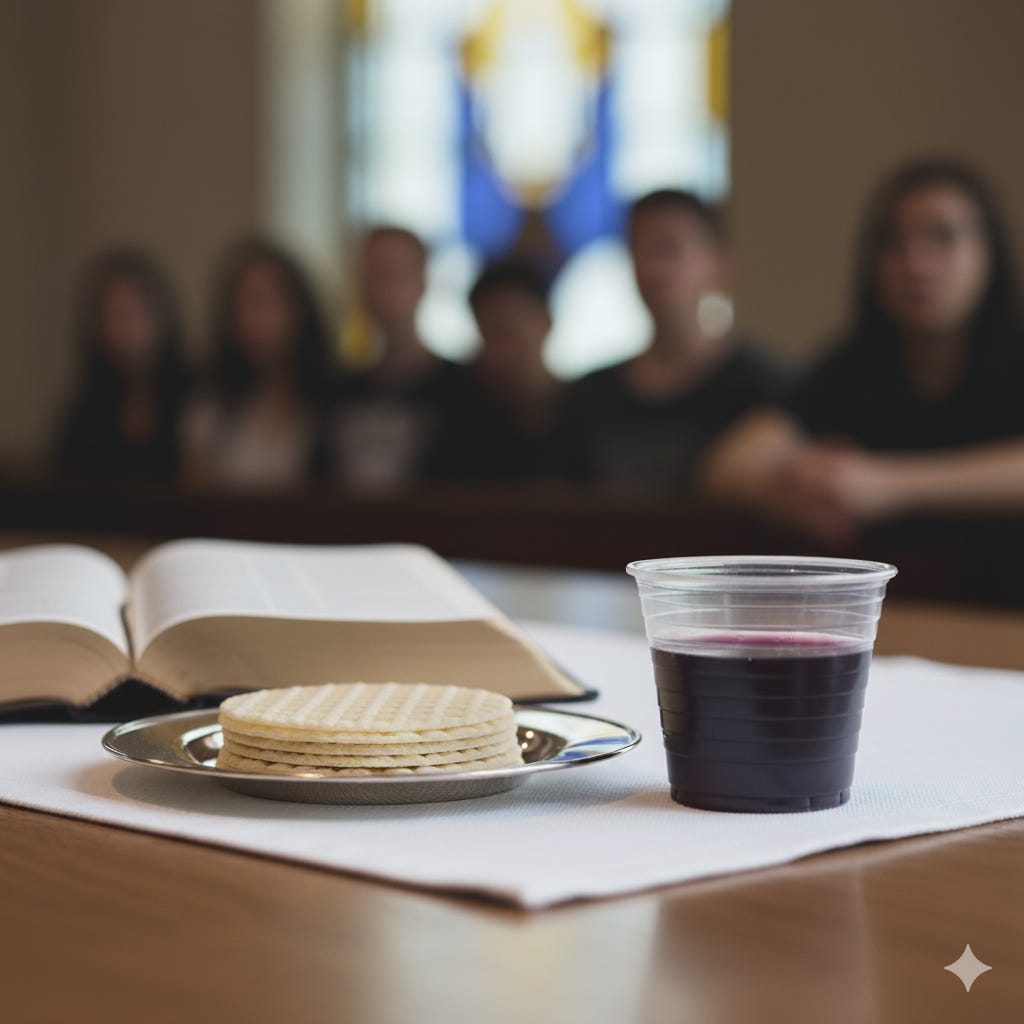
For me, communion has always felt like a very solemn thing. I knew there was power in those moments and I intuitively felt like deep reflection was the right posture to take when partaking in the elements. Others around me have all seemed to feel similarly too.
I thought these verses from 1 Corinthians indicated that examination and self-reflection needed to be directed towards the sin in my life — things that were keeping me from communing fully with God. If I wasn’t repentant, then it would actually be a bad idea for me to participate in communion, since I would be eating and drinking damnation on myself.
So, before I would partake, I would usually take a moment to quietly tell God I was sorry for my sin, ask for forgiveness, and then solemly consume the communion wafer and juice (we didn’t use wine) that symbolized the body and blood of Christ. Usually this would be done with the rest of the Church Body, all of us standing close to the front in the altar area. We would usually take a moment of silence and then all partake together.
There is no doubt that solemnity and repentance are good and Biblical things, yet it wasn’t until recently that I began to really read this passage of Scripture in its fuller context. When I did, I began to realize how much more the practice of communion was supposed to mean for my life.
Allow me to take just a moment to provide a little context. In the chapters leading right up until the passage we just read, the Apostle Paul is addressing various barriers to church unity. He then specifically writes about how we shouldn’t maximize our own freedom and pleasure, if it is going to come at someone else’s expense or make their spiritual walk more difficult. In short, considering what is best for the whole Body instead of just ourselves is what God wants his people to strive for.
With this perspective in mind, let us turn to 1 Corinthians 11:20, just a few verses before the spot we looked at, where Paul begins talking about how the Corinthian church is messing up when parting of the “Lord’s supper” together. This term refers to an early church custom from which we have adapted our modern practice of “communion.”
Speaking of “adapt”, and before we go further, however, let me state that we’re going to notice that what Paul is addressing doesn’t sound like the same scene as the solemn modern-day communion practice I’ve described. I’ll explain more in a second, but for now, just know that the “Lord’s supper” for the Corinthian church consisted of a full meal that everyone brought from their own home — not a small packet with a wafer and juice that an usher handed them when they went to the front of an auditorium. Think of it more like a giant potluck.
Alright, let’s jump in and see why the Apostle Paul was disappointed in what they were doing.
1 Corinthians 11:20-34 (NLT)
20 When you meet together, you are not really interested in the Lord’s Supper. 21 For some of you hurry to eat your own meal without sharing with others. As a result, some go hungry while others get drunk. 22 What? Don’t you have your own homes for eating and drinking? Or do you really want to disgrace God’s church and shame the poor? What am I supposed to say? Do you want me to praise you? Well, I certainly will not praise you for this!
23 For I pass on to you what I received from the Lord himself. On the night when he was betrayed, the Lord Jesus took some bread 24 and gave thanks to God for it. Then he broke it in pieces and said, “This is my body, which is given for you. Do this in remembrance of me.” 25 In the same way, he took the cup of wine after supper, saying, “This cup is the new covenant between God and his people—an agreement confirmed with my blood. Do this in remembrance of me as often as you drink it.” 26 For every time you eat this bread and drink this cup, you are announcing the Lord’s death until he comes again.
27 So anyone who eats this bread or drinks this cup of the Lord unworthily is guilty of sinning against the body and blood of the Lord. 28 That is why you should examine yourself before eating the bread and drinking the cup. 29 For if you eat the bread or drink the cup without honoring the body of Christ, you are eating and drinking God’s judgment upon yourself. 30 That is why many of you are weak and sick and some have even died.
31 But if we would examine ourselves, we would not be judged by God in this way. 32 Yet when we are judged by the Lord, we are being disciplined so that we will not be condemned along with the world.
33 So, my dear brothers and sisters, when you gather for the Lord’s Supper, wait for each other. 34 If you are really hungry, eat at home so you won’t bring judgment upon yourselves when you meet together.
Have you ever heard of the term “Love fest”? It comes partly from an earlier term, “love feast.” This term, in turn, has its roots in a very early practice that historians record about the early Christian, who were known for their “agape feasts.” The term “Agape” as many of you may know, means a generous, giving, or self-sacrificial love. The early Christians were accustomed to celebrating with each other and throwing large feasts where everyone in the church could partake of food and drink to satisfy their hunger and celebrate together. At the end of the feast they would formally celebrate the Eucharist with a ritual partaking of bread and wine to commemorate what Jesus did with His disciples at the Last Supper. This last part is closest to what we would recognize today.
However, over time a pattern in the Corinthian church (and others) emerged — certain people were getting left out of the love. Perhaps they wanted to show up to church, but couldn’t contribute much food to the feast, due to their lack of monetary resources. Perhaps they weren’t comfortable walking up to another table and asking for a bite of food off someone’s plate (I wouldn’t be comfortable doing that either), so they had to push down the feeling of shame and hope that one of their brothers and sisters in Christ would be willing to share with them.
Unfortunately, instead of sharing, those among the community who did have resources began to really lean into the fun that comes from consuming. They began to bring opulent spreads and openly enjoyed the pleasure of deeply indulging — all the while overlooking and ignoring the needs of others at the gathering who had nothing.
Let’s put ourselves in the shoes of a financially poor member of the church during one of these scenes. Just pretend with me for a moment.
The situation isn’t good. You are hungry and your kids are starving too. Yes, you’ve made some poor choices in your life that contributed to you being here. But that was before Christ. When you encountered Jesus, well, the Spirit changed absolutely everything. Jesus has been the best thing that has ever happened to you.
Times are still hard though. The economy isn’t great and the job you do have pays far less than it takes to adequately provide for a family. This weighs on you constantly, but finding a better job just doesn’t seem to be possible at the moment. There a lot of people in a similar boat and everyone is applying to the same positions it seems.
It’s Sunday, the bills are due, and the cupboards are almost bare, but rather than picking up an extra shift at work, you know in your heart that going to church to worship the Lord with fellow believers is the right thing for you and your family to do instead. You’ve heard that the church likes to eat together, but all you can afford to bring right now is a sleeve of peanut butter crackers. Hopefully that is enough to tide the kids over for a few hours. Hopefully you won’t stick out…
Either way, you pack everyone up and head to the gathering, only to be greeted once you arrive with the smells of sizzling steak, warm bread, and the sounds of uproarious laughter from well-dressed people at tables all around. The gathering appears to already be well under way. You glance away awkwardly as you know that bringing your own spread simply isn’t possible right now. Silently, you and your family pick an empty table as far away from the smells as you can manage, but that sirloin is in your brain now.
“I’m hungry,” your youngest says as she pulls at your sleeve and looks at you expectantly. “Can we eat something, please?”
You look around awkwardly again, but no one else at any of the other tables is even willing to meet your eyes. You and your family feel almost… invisible. Instead, all eyes turn to a man who is just arriving with a giant pot of steaming gumbo. He is greeted with a chorus of salutations and slapped on the back merrily. Your heart lifts, thankful for the prospect of a warm bowl of food for you and the kids.
To your shock, however, instead of bringing the pot to some central table for distribution to others who may want a bowl, the man instead plops down on a couch and begins to lavishly shovel steaming broth into his mouth with a ladle — never so much as even glancing your direction.
You glance around, but everyone else seems intent to do similarly, tearing into their steaks, drumsticks, lobsters, and buttery dinner rolls. You look to your left and see a man remove his Rolex and carefully set the watch to the side before diving headfirst into his crockpot full of savory-smelling meat. You look to your right and are astonished to see that someone at the table next to you has drank almost an entire bottle wine all by themselves. Slurring his words, the man glances over, smiles at you, and says, “Welcome to church, brother!” before slumping over, completely intoxicated. Others laugh and carry on, oblivious to your empty table and seemingly engrossed in their own worlds.
You look a little closer at one of the tables and are surprised to see your neighbors. Like, your literal neighbors, Bob and Anne, who live two houses over from you. Sitting next to them is another couple that often are customers at the business that employs you. Hope rises within you. If anyone knows of your situation and might be willing to help, it would be them. However, your hopes are quickly dashed as you realize the empty plates scattered about their table. You’ve apparently arrived too late. You make eye contact with Bob and Anne and they give a very friendly wave and smile and before returning to their conversation.
You are stunned, ashamed, confused, and entirely unsure what to do or say next. Do you just stand up and announce your poverty to the room? Do you directly approach another table and break up a conversation to ask if you can take some of their food? Maybe it’s good that you were a little late. Maybe its a good idea to leave a little early.
You stand to gather your things and family, but, just as you prepare to make a hasty retreat, a voice from the front of the room calls out, “Greetings dear brothers and sisters! It’s time for us to take a moment to remember our Lord!”
An usher of some kind quickly passes out small crackers, dropping a few at your table. You look at them, unsure of whether to be grateful, disappointed, or beat yourself up for making church about material things at all. You feel guilty, knowing that a sense of entitlement isn’t warranted — after all, no one here owes you anything. No law says that anyone here should be obligated to share. You should probably learn to be content with your peanut butter crackers. Either way, you know you should be focused on Jesus right now, not about fleshly satisfaction…
…but your stomach is rumbling nonetheless, and the sight of the food and riches around you is making it hard to concentrate on God.
“Let all of us take a solemn moment to examine ourselves before we partake of the Body and Blood of Christ.” the man at the front says.
In the long moment that follows you think of your own sin and how grateful you are that Jesus chose to die for you. Surprisingly, the rest of the room seems to really be focused on this moment too. The raucous sounds of joyous feasting have given way to solemnity. You hear several couples at nearby tables whispering prayers of thankfulness to God for all the blessings He’s poured out on their life.
As everyone lifts their communion crackers together in unity, you catch a gleam of light in the corner of your eye as the man with the Rolex raises the cracker to his mouth. You can’t help but think about the stack of bills on the kitchen table waiting for you at home and almost miss the next moments of the service entirely as you are lost in thought.
As the service concludes, you stuff some peanut butter crackers in your kids’ mouths and take a few nibbles yourself. This has been a hard morning, but maybe this a good lesson that God wants to teach you or something. Maybe its also a lesson you don’t want to learn again.
“Hey there!” interjects a voice, cutting through your darkening thoughts. “Its good to see you guys — we’ve been praying for you! How are things going?” You look up to see Bob and Anne standing there, looking at you with what appears to be a caring expression on their faces.
"Um… good. Things are good.” You mumble, trying to be polite, but inwardly kicking yourself for lying. Bob’s suit and nice shoes glisten in the light as he leans forward and says, “Don’t worry, we’ll be continuing to pray for God’s provision in your situation.”
“Thanks” you say, and do your best to wrap up the conversation. I mean, what else are you supposed to say to something like that? You look at your own plain clothes compared to Bob’s and honestly just want to hide.
As if things couldn’t get worse, the man at the front of the room calls out, “Oh, I almost forgot to give the announcements. Everyone please be sure to give your tithes and offerings — today is missions Sunday!”
You almost cry as you see the people in the room begin to pass around a collection plate. By the time it passes by you, it has several hundred dollars in it at least. You look away. This is too much. You don’t like how this is making you look at your new brothers and sisters. You don’t like the entitled feelings this is bringing up within yourself. Is this what a walk with Christ is supposed to feel like?
Mumbling something unintelligible to Bob and Anne, you grab your family and go. Maybe your relationship with God would be better served by staying away from church for a little bit until you have more money…
Now, obviously this was all just a made up story, but this image certainly seems to fit better with the scenario that the Apostle Paul appears to be addressing, especially considering the historical context we’ve learned about.
What does all of this have to do with us though? Most of us don’t have feasts in our church buildings that often and, obviously, I’m not expecting everyone to share the little bits of wafer and juice from whenever we take our modern version of communion. But what I am asking us to do is take a second, when we come to communion, to ask ourselves “who, exactly, am I supposed to be communing with right now?”
Yes, God wants us to think about Him and examine ourselves, but the context of the scriptures we’ve read shows us that one of the main things God wants us to be thinking about not just our relationship to Him, but our relationship to each other. Even if no one is specifically getting drunk at church anymore, there are likely parallel stories similar to the one we explored happening all across America every Sunday. People around us who are struggling to pay the bills and provide for their families. Even worse, what if there aren’t any in need at our church. What would that indicate about us?
Let’s take a look at what other passages of scripture have to say about this though.
James 2:14-17 (NIV)
14 What good is it, my brothers and sisters, if someone claims to have faith but has no deeds? Can such faith save them? 15 Suppose a brother or a sister is without clothes and daily food. 16 If one of you says to them, “Go in peace; keep warm and well fed,” but does nothing about their physical needs, what good is it? 17 In the same way, faith by itself, if it is not accompanied by action, is dead.
1 John 3:17-18 (NIV)
17 If anyone has material possessions and sees a brother or sister in need but has no pity on them, how can the love of God be in that person? 18 Dear children, let us not love with words or speech but with actions and in truth.
Philippians 2:1-4 (NIV)
“1Therefore if you have any encouragement from being united with Christ, if any comfort from his love, if any common sharing in the Spirit, if any tenderness and compassion, 2 then make my joy complete by being like-minded, having the same love, being one in spirit and of one mind. 3 Do nothing out of selfish ambition or vain conceit. Rather, in humility value others above yourselves, 4 not looking to your own interests but each of you to the interests of the others.
Acts 4:32-35 (NIV)
32 All the believers were one in heart and mind. No one claimed that any of their possessions was their own, but they shared everything they had. 33 With great power the apostles continued to testify to the resurrection of the Lord Jesus. And God’s grace was so powerfully at work in them all 34 that there were no needy persons among them. For from time to time those who owned land or houses sold them, brought the money from the sales 35 and put it at the apostles’ feet, and it was distributed to anyone who had need.
Scripture is clear that we need to be looking out not just for our own needs, but for the needs of others too. Now, in our modern context, you may or may not have extra food to share, and your neighbor next to you may or may not need an extra meal, specifically. The point of communion is about more than sharing food, however, (although it certainly includes that). Jesus broke the bread and gave the wine as an analogy of how he was going to give everything for those He loved, even if that meant going through suffering. And when Jesus said “Do this in remembrance, of me,” to what action do the words, “do this,” refer? Well the consuming of the food and drink He was distributing is certainly part of it, but the very preceding words were, “This is my body, which is given for you.” I believe Jesus was telling his disciples not just to be consumers, but to mirror Him and become givers. It echoes His words from a different context in Matthew 10:8 "Freely you have received; freely give.”
In the same way, when we eat the bread and drink from the cup, we need examine ourselves and, instead of only thinking about what we need to repent for, we should also ask ourselves, “What can I give and who might need what I have?”
Maybe what you have is land and money. Maybe you have food. Maybe you have time. Maybe all you can give someone is your full attention — someone next to you who might need a friend more than anyone would ever know. Maybe you can give your time in prayer for people. Maybe you can just give your presence.
Either way, before we break the bread and drink the cup next time, let us all take a second to thank the Lord for all He has given us and then ask Him to show us what we can give and who might need it. If we want to commune with Him, it cannot be separated from how we commune with each other.
May the Sprit empower us to give as freely as we have received.
With love,
-Nathan Marlette
Thank you for sharing your Substack with me! It has been a pleasure reading your posts. You pointed out an essential part of communion that most of us sinners neglect. Maybe in today's temptations towards hyperindividualism it is the hardest part of the Christian life. Holy communion is integration which is both vertical (uniting with God) and horizontal (uniting with each other). Without the vertical integration, we become a social club. Without the horizontal integration, we have an atomized "just me and God" existence.
As St Paul explains in 1 Corinthians 15, partaking unworthily of the Eucharist can harm us. This includes approaching the Eucharist in a state of unrepentant sin, includng callous or indifferent actions towards others. Communing in an unworthy manner may steepen us further in our sins, hardening our hearts toward our neighbor.
The Christian tradition, and Holy Scripture itself, points to us becoming fully realized in our human nature only when we are in right relation to others. The Bible plays with the singular and the plural, juxtaposing the unity of mankind's one substance with the distinction of persons within that one substance which are wholly unique and never interchangeable:
"...in the day that God created Adam, He made HIM in the likeness of God. Male and female he created THEM..." (Genesis 5:1-2)
"And if they were all one member, where would the body be? But now there are indeed many members, but one body." (1 Corinthians 12:20-21)
The late Pope Benedict XVI, following the tradition of Augustine's analogy of the Godhead, suggested that mankind might be better understood, not as a collection of individual body-soul unions, but as a single physical/spiritual substance, with the individual persons being "relations within the one substance." For if we were truly created as individual, atomized instantiations of one single nature, why are no two human beings interchangeable, like tires in a factory?
https://www.communio-icr.com/files/ratzinger17-3.pdf
If this conception of the human person as a "relation in substance" is accurate, then we can never genuinely be in right relation to God without also being in right relation to others. This is because Christ has truly united the created human substance to the uncreated divine substance. Any attempt to sever our connection with others is to, quite literally, sever our connection to God, right down to the material level.
Therefore, holy communion should be approached with the utmost seriousness. In the ancient Christian tradition, it is the very means by which God normally saves us and unites us to himself. While God can save anyone he wishes (thief on the cross), the normative means he provided for our salvation was taking on our human nature with no change to his divinity, and literally uniting his fully divine human body to ours, making us "partakers of the divine nature" (2 Peter 1:4) and healing us from the inside.
The apostle John speaks of κοινωνία, ("koinonia," often translated as "fellowship" but understood by the Church Fathers more properly as "communion," and inseparable from the Eucharist, the very body and blood of the Lord Jesus which was sacrificed for us):
"If we say that we have communion with Him, and walk in darkness, we lie and do not practice the truth. But if we walk in the light as He is in the light, we have communion with one another, and the blood of Jesus Christ His Son cleanses us from all sin." (1 John 1:6-7)
The tree of life in the Garden of Eden is Christ on the cross. We eat its fruit and become its branches on the tree.